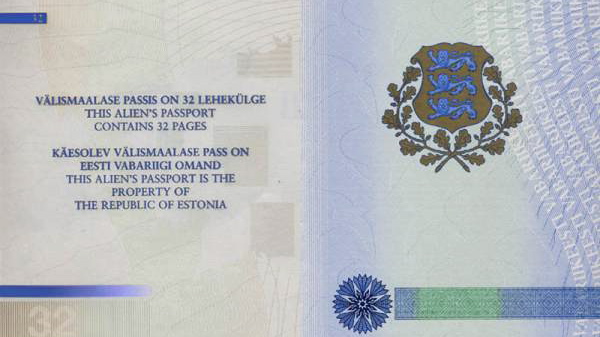
About 8 percent of Estonia's population are not citizens and have alien's passports like this, a legacy of the Soviet Union and Estonia's stringent citizenship requirements.
TALLINN — The European Commission against Racism and Intolerance, an arm of the Council of Europe, released a report Tuesday strongly criticizing the number of stateless persons in Estonia as too high.
Currently 8 percent of the Estonian population is stateless. Although the number is declining, the commission still considers it too high and called out the smallest Baltic state for having overly strict language requirements and noting that the number of unemployed people among ethnic minorities is twice as [private_supervisor]high as for ethnic Estonians.
“The naturalization process is still hampered by too stringent language and other requirements. It is important that dialogue be maintained between the authorities and persons without citizenship on the measures to be taken,“ was noted in the report.
A UN Human Rights Council report from 2007 accused Estonia of taking too little concrete action to address the statelessness of ethnic Russians and ease the language policy. Although efforts have been made since then, many ethnic Russians may still consider the citizenship process too difficult, even though they were born in Estonia.
Maksim, 28 of Tallinn, is an ethnic Russian information technology worker told Baltic Reports that it is harder to get a job for him than for ethnic Estonians he knows, and that getting a national passport is too arduous.
“I don’t have any other homeland besides Estonia, Russia is not my home,” Maksim said. He still carries an alien passport.
Kristel Tuul, a spokeswoman for the Ministry of Interior, said the state will take the commission’s report under consideration and continue working to further integration among Estonia’s ethnic groups. Steps have been taken to simplify the citizenship process by reducing the wait time from one year to six months and compensating for Estonian language courses.
Tuul noted that 32 percent of the population had an unspecified nationality in 1992, but today the number is down to 8 percent.
“This positive trend shows the interest towards the Estonian nationality, and more and more people have made that choice,” Tuul told Baltic Reports.
Not being addressed
There seems to be little political will to address the problem, though, either on the Estonian left or right. Katrin Saks, a former minister of population and currently the vice chairman of Tallinn City Council said on a Kuku Radio program Wednesday that stateless people and language problem is a problem in Estonia, but the country does not have many means to reduce the number of stateless persons.
Saks said that as European Union allows to travel with the alien passport, and Russia does not require visas for them then the stateless persons are even favored and are not motivated to apply for the citizenship. [/private_supervisor] [private_subscription 1 month]high as for ethnic Estonians.
“The naturalization process is still hampered by too stringent language and other requirements. It is important that dialogue be maintained between the authorities and persons without citizenship on the measures to be taken,“ was noted in the report.
A UN Human Rights Council report from 2007 accused Estonia of taking too little concrete action to address the statelessness of ethnic Russians and ease the language policy. Although efforts have been made since then, many ethnic Russians may still consider the citizenship process too difficult, even though they were born in Estonia.
Maksim, 28 of Tallinn, is an ethnic Russian information technology worker told Baltic Reports that it is harder to get a job for him than for ethnic Estonians he knows, and that getting a national passport is too arduous.
“I don’t have any other homeland besides Estonia, Russia is not my home,” Maksim said. He still carries an alien passport.
Kristel Tuul, a spokeswoman for the Ministry of Interior, said the state will take the commission’s report under consideration and continue working to further integration among Estonia’s ethnic groups. Steps have been taken to simplify the citizenship process by reducing the wait time from one year to six months and compensating for Estonian language courses.
Tuul noted that 32 percent of the population had an unspecified nationality in 1992, but today the number is down to 8 percent.
“This positive trend shows the interest towards the Estonian nationality, and more and more people have made that choice,” Tuul told Baltic Reports.
Not being addressed
There seems to be little political will to address the problem, though, either on the Estonian left or right. Katrin Saks, a former minister of population and currently the vice chairman of Tallinn City Council said on a Kuku Radio program Wednesday that stateless people and language problem is a problem in Estonia, but the country does not have many means to reduce the number of stateless persons.
Saks said that as European Union allows to travel with the alien passport, and Russia does not require visas for them then the stateless persons are even favored and are not motivated to apply for the citizenship. [/private_subscription 1 month] [private_subscription 4 months]high as for ethnic Estonians.
“The naturalization process is still hampered by too stringent language and other requirements. It is important that dialogue be maintained between the authorities and persons without citizenship on the measures to be taken,“ was noted in the report.
A UN Human Rights Council report from 2007 accused Estonia of taking too little concrete action to address the statelessness of ethnic Russians and ease the language policy. Although efforts have been made since then, many ethnic Russians may still consider the citizenship process too difficult, even though they were born in Estonia.
Maksim, 28 of Tallinn, is an ethnic Russian information technology worker told Baltic Reports that it is harder to get a job for him than for ethnic Estonians he knows, and that getting a national passport is too arduous.
“I don’t have any other homeland besides Estonia, Russia is not my home,” Maksim said. He still carries an alien passport.
Kristel Tuul, a spokeswoman for the Ministry of Interior, said the state will take the commission’s report under consideration and continue working to further integration among Estonia’s ethnic groups. Steps have been taken to simplify the citizenship process by reducing the wait time from one year to six months and compensating for Estonian language courses.
Tuul noted that 32 percent of the population had an unspecified nationality in 1992, but today the number is down to 8 percent.
“This positive trend shows the interest towards the Estonian nationality, and more and more people have made that choice,” Tuul told Baltic Reports.
Not being addressed
There seems to be little political will to address the problem, though, either on the Estonian left or right. Katrin Saks, a former minister of population and currently the vice chairman of Tallinn City Council said on a Kuku Radio program Wednesday that stateless people and language problem is a problem in Estonia, but the country does not have many means to reduce the number of stateless persons.
Saks said that as European Union allows to travel with the alien passport, and Russia does not require visas for them then the stateless persons are even favored and are not motivated to apply for the citizenship. [/private_subscription 4 months] [private_subscription 1 year]high as for ethnic Estonians.
“The naturalization process is still hampered by too stringent language and other requirements. It is important that dialogue be maintained between the authorities and persons without citizenship on the measures to be taken,“ was noted in the report.
A UN Human Rights Council report from 2007 accused Estonia of taking too little concrete action to address the statelessness of ethnic Russians and ease the language policy. Although efforts have been made since then, many ethnic Russians may still consider the citizenship process too difficult, even though they were born in Estonia.
Maksim, 28 of Tallinn, is an ethnic Russian information technology worker told Baltic Reports that it is harder to get a job for him than for ethnic Estonians he knows, and that getting a national passport is too arduous.
“I don’t have any other homeland besides Estonia, Russia is not my home,” Maksim said. He still carries an alien passport.
Kristel Tuul, a spokeswoman for the Ministry of Interior, said the state will take the commission’s report under consideration and continue working to further integration among Estonia’s ethnic groups. Steps have been taken to simplify the citizenship process by reducing the wait time from one year to six months and compensating for Estonian language courses.
Tuul noted that 32 percent of the population had an unspecified nationality in 1992, but today the number is down to 8 percent.
“This positive trend shows the interest towards the Estonian nationality, and more and more people have made that choice,” Tuul told Baltic Reports.
Not being addressed
There seems to be little political will to address the problem, though, either on the Estonian left or right. Katrin Saks, a former minister of population and currently the vice chairman of Tallinn City Council said on a Kuku Radio program Wednesday that stateless people and language problem is a problem in Estonia, but the country does not have many means to reduce the number of stateless persons.
Saks said that as European Union allows to travel with the alien passport, and Russia does not require visas for them then the stateless persons are even favored and are not motivated to apply for the citizenship. [/private_subscription 1 year]
— This is a paid article. To subscribe or extend your subscription, click here.