
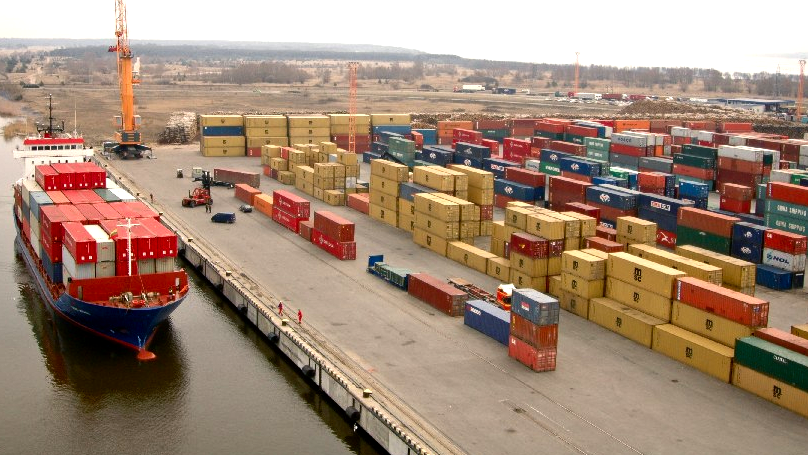
Lithuania's increased exports are a positive indication given the weak state of its economy and may indicate a trend to correct the current account balances deficits that were a trademark of the "Baltic Tiger" years. Photo used courtesy of the Port of Klaipėda.
VILNIUS — Lithuania’s exports increased 8.7 percent from August to September, the second month in a row exports have gone up according to the Baltic nation’s Department of Statistics.
The drive-up in exports, after a momentous drop earlier this year caused by the crisis that shows Septembers year-on-year export level down 31 percent, is fueled by increased demand for food products, plastics, wood products and paper in Western European nations such as Germany and France that have turned their economies around and those that are near to approaching recovery like the Netherlands.
The increased trade activity is not stopping Lithuania’s deflationary trend that is gone on nearly every month since April. According to the Department of Statistics, prices for consumer goods and services in October went down o.4 percent from September.
Given the state of the Lithuanian economy and the oncoming winter season with its added expenditure of heating bills and price reductions for pre-Christmas sales, economists do not expect inflation to return for at least several months.
“There is no ground to expect inflation to remain now. Demand is still very weak and it will not pull inflation up not even until next year,” Vilija Tauraitė, a senior economist at SEB’s Lithuanian subsidiary, told Baltic Reports. “The only exception is monthly deflation since April was Sept. and that was purely the value-added tax effect.”
The Lithuanian government increased the VAT from 19 percent to 21 percent this summer to hold off an unmanageable budget deficit.
Despite the crisis year-on-year inflation still increased 1.3 percent despite the profound drops in Lithuanian wages and real estate. Given the interdependence of the nation’s economy on neighbors that have not undergone such significant cost reductions, though, prices have not fallen with wages and property values.
“Some of the costs for production are constant, they are not decreasing,” Tauraitė said. The market is not as flexible as wages, and the wages are only a share of the production cost and also we have tax increases.”